


What the business thinks the problem is
When an AI initiative stalls, the conversation inside the organisation almost always lands on the data. The data is not clean enough. Not complete enough. The wrong format. The platform is not ready.
These are real problems. I am not dismissing them. But in my experience, they are symptoms. The actual cause sits upstream of all of them and it almost never comes up when people talk about AI readiness.
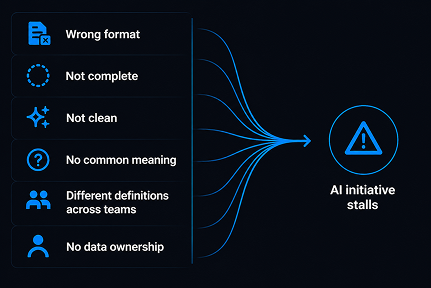
The real cause is simpler than most people expect. The organisation has never sat down and formally agreed on what its data means. Not how to store it. Not how to move it. What it actually means. What counts as a customer. What counts as a completed transaction. What the right definition of revenue is when three subsidiaries each have their own reasonable answer.
For 30 years, enterprises navigated this informally. The analyst who knew which system to trust became invaluable. The manager who had worked there long enough to know that the Oracle number and the SAP number were always off by exactly the inter-company transaction amount, they became irreplaceable. Nobody wrote any of this down. The people in the room already knew it.
AI does not already know it. And unlike a human colleague,
it will not ask.
Why this is harder than it sounds
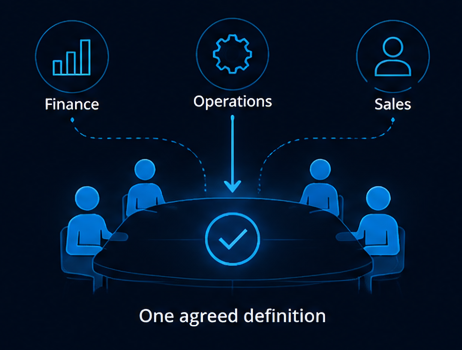
I want to be honest about this. The meeting where a business actually agrees on its canonical definitions is one of the hardest meetings an organisation can hold.
Finance, operations, and sales all have to sit in the same room and admit they have been working from different versions of the truth. Someone has to have enough authority to make a binding call and enough patience to hear everyone out first.
In my experience, this is exactly why it gets deferred. Not because people do not understand how important it is. But because holding the meeting feels more expensive than keeping the workaround. Until AI arrives. At which point there is no more workaround.
Why it keeps getting deferred
Every team has its own definition and believes theirs is the right one
Fixing the definition changes numbers people have reported against for years
Nobody has both the authority and the incentive to make the call
Living with the workaround has always felt easier than having the conversation
What deferral actually costs
AI programmes that stall or get quietly cancelled
Teams rebuilding the same logic independently, over and over
The workaround gets embedded so deep it becomes the architecture
A data estate that costs more to maintain every year and delivers less
A single question worth asking

The diagnostic
If I gave your AI a question that requires joining data from three of your systems, what would the answer be? Would every leader in the room trust it?

If the answer is no, or if there is any hesitation before the yes, the platform does not matter yet. Neither does the pipeline. The conversation about what the data means has to happen first.
When organisations do finally resolve this, when they hold the meeting, make the decisions, and document the canonical definitions, the engineering work that follows has a name.

Silver Layer
Where three definitions of customer become one. Where post-acquisition data debt gets paid rather than passed downstream.
The engineering is genuinely not the hard part. It has never been. The hard part is the conversation that has to happen before a single line of code gets written.
Understand definitions
Align and document
Engineer and enforce
Build AI on trusted data